When you’re planning a new business website, one of the first decisions you may face is whether to use WordPress or build a website from scratch.
You may hear arguments for both sides.
One developer might tell you that WordPress is the easiest and most cost-effective option. Another might recommend a custom-built website because it offers more flexibility and control.
So which one is actually better?
There isn’t one answer for every business.
The right choice depends on your website’s requirements, budget, functionality, future plans and how much control you need over the system.
Let’s look at the differences so you can make a more informed decision.
What Is a WordPress Website?
WordPress is a content management system (CMS) that allows businesses to build and manage websites without developing every feature from scratch.
A WordPress website can use themes and plugins to provide functionality such as:
- Business pages
- Contact forms
- Blogs
- Booking systems
- Online stores
- Payment integrations
- Membership systems
- SEO tools
- Customer enquiry systems
A developer can also customize the design and functionality when the standard options aren’t enough.
This makes WordPress suitable for a wide range of businesses, from small company websites to more complex websites and online stores.
What Is a Custom Website?
A custom website is developed specifically for a particular business rather than being built primarily around an existing CMS and its ecosystem.
Developers can create the website’s frontend, backend, database structure and functionality according to the project’s requirements.
This approach can make sense when a business needs functionality that doesn’t fit well into existing platforms.
For example, a company might require:
- A custom customer portal
- Complex business workflows
- Specialized booking systems
- Custom dashboards
- Integration with internal software
- Industry-specific functionality
- A highly customized backend system
A custom website gives developers much more control over how the system works.
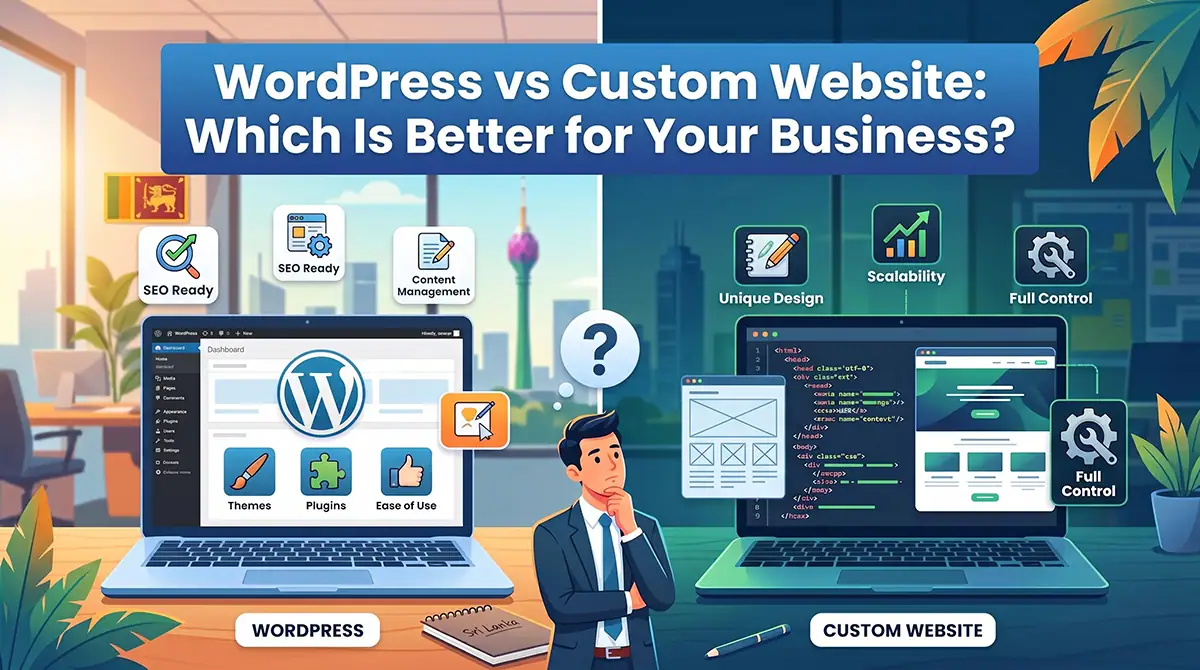
WordPress vs Custom Website: The Main Differences
| Factor | WordPress | Custom Website |
|---|---|---|
| Development time | Usually faster | Usually longer |
| Initial cost | Often lower | Usually higher |
| Customization | High | Very high |
| Content management | Easy for most businesses | Depends on the system |
| Plugins/integrations | Large ecosystem | Built as required |
| Maintenance | Requires CMS/plugin updates | Depends on technology |
| Complex functionality | Possible with customization | Excellent |
| Scalability | Good when properly developed | Can be highly scalable |
| Technical expertise | Easier for businesses to manage | Usually requires developers |
These are general differences. A well-developed WordPress website can be far more capable than a poorly developed custom website.
When WordPress Is the Better Choice
For many businesses, WordPress is the practical choice.
1. You Need a Business Website
If your main requirement is a professional website with pages such as:
- Home
- About
- Services
- Portfolio
- Blog
- Contact
there is usually little reason to build a complete CMS from scratch.
WordPress can provide the foundation while allowing a developer to customize the design and functionality around your business.
2. You Need an Online Store
If you want to sell products online, WordPress combined with WooCommerce can provide a strong foundation for an eCommerce website.
You can add products, manage orders, configure shipping, integrate payment gateways and expand the store as your business grows.
3. You Want to Manage Content Yourself
Businesses often need to update their own website.
You might want to add a new service, publish a blog post, change a phone number or update product information without contacting a developer every time.
A CMS such as WordPress makes this much easier.
4. You Have a Limited or Moderate Budget
A custom website requires developers to build functionality that established platforms may already provide.
If your business doesn’t need specialized functionality, paying to recreate those features may not provide much additional value.
WordPress can reduce development time and therefore make a professional website more accessible to smaller businesses.
5. You Want to Start Quickly
A WordPress project can often move from planning to launch faster than a completely custom system, particularly when the required functionality is already supported by reliable plugins or standard development components.
That can be useful for a new business that needs to establish an online presence quickly.
When a Custom Website May Be Better
WordPress isn’t the right solution for everything.
There are situations where custom development makes much more sense.
1. You Need Unique Functionality
Suppose your business has a workflow that doesn’t fit existing WordPress plugins.
For example, you may need a system where customers submit information, employees review it, different departments process it and customers receive updates through their own dashboards.
Building that system specifically around your workflow may be more appropriate than trying to force multiple plugins to work together.
2. You Need a Web Application
There’s a difference between a business website and a web application.
A website primarily provides information and helps visitors interact with a business.
A web application may involve:
- User accounts
- Dashboards
- Complex data
- Real-time functionality
- Advanced permissions
- Automated workflows
- Large amounts of user-generated information
For these types of projects, custom development can offer greater control over the architecture.
3. You Have Complex Integrations
Some businesses need their website to communicate with internal systems, third-party APIs, inventory platforms, CRM systems or other software.
If those integrations have highly specific requirements, a custom application may be the better technical solution.
4. Your Requirements Go Beyond WordPress
Sometimes the question isn’t whether WordPress can technically do something.
With enough development work, WordPress can be customized extensively.
The better question is:
Is WordPress the most appropriate foundation for what you’re trying to build?
If achieving your requirements involves excessive customization, dozens of dependencies or complicated workarounds, another technology may be a better long-term choice.
What About Website Performance?
You may have heard that custom websites are always faster than WordPress websites.
That’s an oversimplification.
A poorly developed WordPress website can certainly become slow. Too many plugins, large images, inefficient code, poor hosting and unnecessary functionality can all affect performance.
But a properly developed WordPress website can also perform very well.
Likewise, a custom website isn’t automatically fast simply because it is custom-built. Its performance depends on the architecture, code, database, hosting and optimization.
Good development matters more than the label “WordPress” or “custom.”
What About SEO?
Both WordPress and custom websites can be optimized for search engines.
WordPress has an advantage in terms of the number of SEO tools and plugins available, but installing an SEO plugin doesn’t automatically make a website SEO-friendly.
Your website still needs:
- Good site structure
- Useful content
- Proper headings
- Search-friendly URLs
- Internal linking
- Mobile-friendly design
- Good performance
- Appropriate metadata
- A technically sound foundation
A custom website can also achieve all of these things when developers build the system correctly.
The platform itself isn’t your entire SEO strategy.
What About Security?
Both approaches require proper security practices.
WordPress websites need attention to:
- WordPress core updates
- Plugin updates
- Theme updates
- Strong passwords
- User permissions
- Backups
- Secure hosting
Custom websites have their own security considerations, including the quality of the application code, server configuration, authentication and third-party integrations.
Choosing custom development doesn’t automatically make a website secure.
Likewise, choosing WordPress doesn’t automatically make it insecure.
Security depends heavily on how the website is developed, configured and maintained.
Which Is More Expensive?
There is no universal price for either option.
However, custom development will generally require more development work when the same functionality could already be provided by an established platform.
With WordPress, developers can build on an existing CMS and ecosystem.
With a custom solution, more components may need to be designed and developed specifically for your project.
But don’t choose WordPress simply because it’s cheaper.
If your business requires a custom application, saving money on development by forcing everything into WordPress could create bigger problems later.
The goal should be to choose the right technology for the requirements, not simply the lowest initial price.
Can a WordPress Website Be Customized?
Yes.
This is an important point that often gets overlooked.
Choosing WordPress doesn’t mean you’re limited to an off-the-shelf template.
A developer can customize:
- The website design
- Theme functionality
- Templates
- WooCommerce
- Plugins
- Forms
- User roles
- APIs
- Database functionality
- Business-specific features
In fact, many professional WordPress projects combine the flexibility of WordPress with custom development.
This can provide a useful middle ground between a standard template website and a completely custom application.
WordPress or Custom Website: Which Should You Choose?
A simple way to think about it is:
Choose WordPress if:
- You need a professional business website
- You need an online store
- You want to manage content yourself
- Your requirements fit established website functionality
- You want a practical development budget
- You need to launch relatively quickly
Consider custom development if:
- You need highly specialized functionality
- You’re building a web application
- You have complex business workflows
- You require extensive custom integrations
- Existing platforms create unnecessary limitations
- Your project requires complete control over the application’s architecture
And there is a third option:
Use WordPress as the foundation and add custom development where necessary.
For many businesses, this can provide the best balance between flexibility, development cost and long-term manageability.
Don’t Choose the Technology Before Defining the Requirements
One of the biggest mistakes businesses make is starting the conversation with:
“I want a WordPress website.”
or:
“I want a custom website.”
Instead, start with:
“This is what I need my website to do.”
Explain your business, customers, required features, integrations and future plans.
Then let an experienced developer recommend the most appropriate solution.
The technology should support your business requirements—not the other way around.
Final Thoughts
WordPress and custom development are both valuable approaches.
For many small and medium-sized businesses, WordPress provides an excellent balance of cost, flexibility, content management and available functionality.
For businesses with highly specialized requirements or complex web applications, custom development may be the better investment.
The important thing is not choosing the technology that sounds more advanced.
It’s choosing the technology that solves your actual business problem without creating unnecessary complexity or cost.
If you’re planning a new website and aren’t sure whether WordPress or a custom solution is right for your business, Web One Solutions can help you evaluate your requirements and choose an appropriate development approach.