Social media has changed the way businesses connect with customers. Platforms such as Facebook, Instagram, TikTok and LinkedIn allow businesses to promote products, share updates and communicate directly with potential customers.
Because of this, many small businesses ask an important question, “Do I really need a website if I already have social media?”. Our Website vs Social media guide will help
For some businesses, social media may be where most customer interactions happen. But that does not mean a social media page can fully replace a business website.
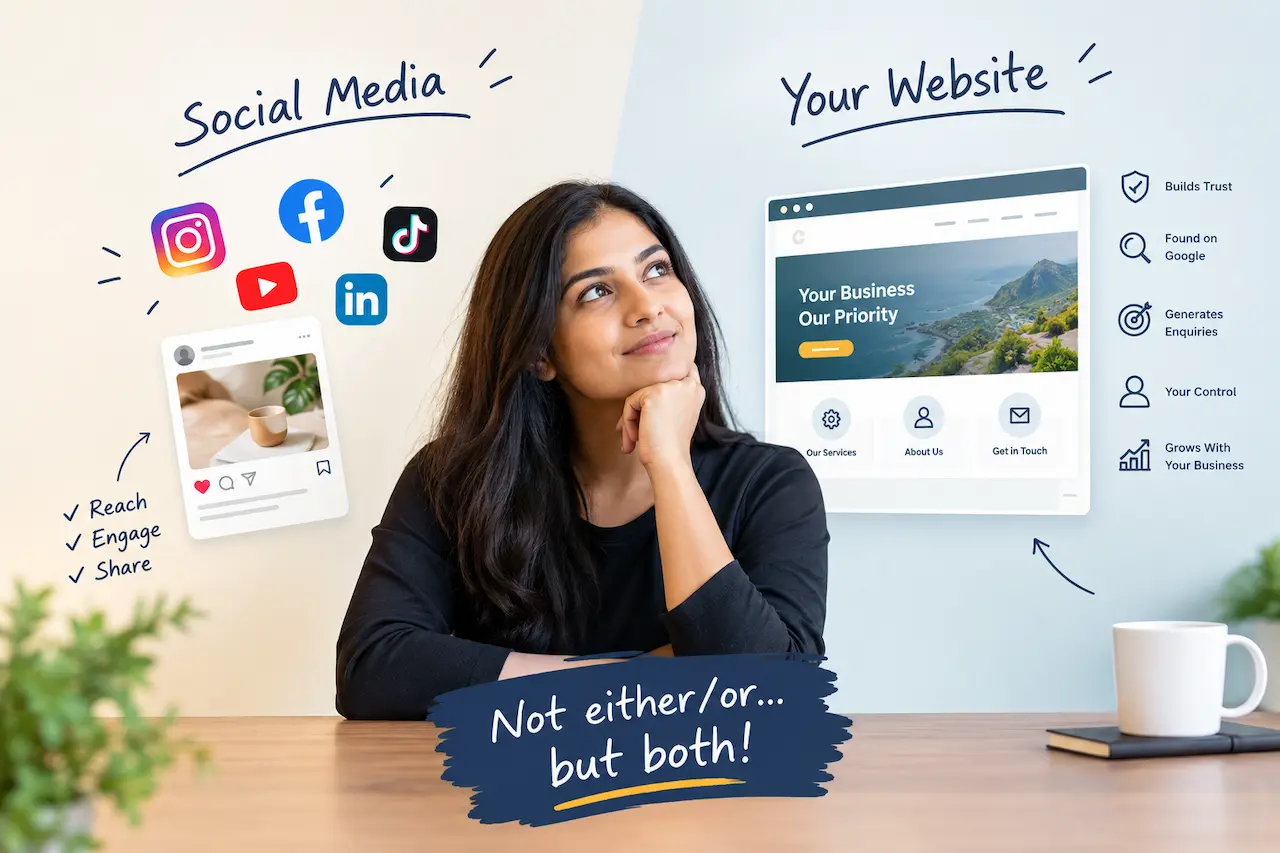
A social media presence and a website serve different purposes. Social media helps you reach and engage people, while your website gives your business a professional online home that you control.
For most businesses, the strongest approach is not choosing between the two. It is using them together.
Website vs Social Media: What’s the Difference?
Before deciding what your business needs, it helps to understand the role each platform plays.
A business website is a dedicated online presence for your company. You control its content, structure, branding and the information customers see.
Social media is a platform provided by another company where you build a profile and interact with an audience.
For example, a restaurant might use Instagram to share food photos and promotions, while its website provides the complete menu, location, opening hours, reservations and other important information.
Both can be valuable, but they are not interchangeable.
| Business Website | Social Media |
|---|---|
| Your own online presence | Profile on another platform |
| You control the content and structure | Platform controls the environment |
| Can appear in Google search | Mainly reaches users within the platform |
| Can provide detailed information | Better suited to short-form updates |
| Can generate enquiries and leads | Strong for engagement and interaction |
| Can support online payments and bookings | Useful for promotions and communication |
| Builds a central brand presence | Helps build an active audience |
The question is therefore not whether your business should have a website or social media.
For most businesses, the better question is, how can you use both effectively?
1. Social Media Helps You Reach People, But Your Website Gives Them Somewhere to Go
Social media is excellent for getting attention. You can publish a new product, share a customer review, post a video or promote an offer and potentially reach hundreds or thousands of people. But what happens when someone wants more information?
They may want to
- Learn about all your services
- See your complete product range
- Read about your company
- Check your pricing or packages
- Find your location
- Make an enquiry
- Book a service
- Purchase a product
- Contact your business
A social media profile can provide some of this information, but it can quickly become difficult to organise everything clearly.
Your website can act as the central destination where customers find everything they need. You can use social media to attract attention and then direct interested customers to your website.
2. A Website Makes Your Business Look More Established
Customers often judge a business by its online presence before deciding whether to contact it.
A well-designed website can help communicate that your business is established, professional and serious about what it offers.
This is particularly important for service businesses.
Imagine someone finds a company through Facebook and wants to know more. They click through to the company’s website and find,
- A professional homepage
- Clear information about the business
- Detailed service pages
- Previous work or case studies
- Customer testimonials
- Contact information
- Frequently asked questions
- A clear way to request a quotation
That gives the customer much more confidence than a social media profile alone.
A website does not automatically make a business trustworthy, but a professional website can support that trust when the content and experience are well presented.
3. Your Website Can Help Customers Find You on Google
One of the biggest differences between a website and social media is how people discover them.
Social media is largely built around people browsing a particular platform. Your content can reach followers and, depending on the platform, new users through recommendations, advertising and sharing.
A website gives your business another opportunity, search engines such as Google.
Someone might search for,
- Web design company in Colombo
- Wedding photographer in Sri Lanka
- Hotel in Ella
- Construction company in Kandy
- Accounting services in Sri Lanka
- Online clothing store in Sri Lanka
A properly structured website can target relevant searches and bring potential customers to your business.
This is where SEO becomes important.
Building search visibility takes time, and having a website does not guarantee that your business will appear at the top of Google. However, without a dedicated website, your ability to build a long-term search presence is much more limited.
4. Your Website Gives You More Control
When you create a social media page, you are building your business presence on someone else’s platform. The platform decides how profiles look, what features are available, how content is distributed and how users interact with it. A website works differently.
You have much greater control over:
- Design
- Branding
- Content
- Navigation
- Services and products
- Contact forms
- Enquiry processes
- Bookings
- Payments
- Customer experience
This flexibility becomes increasingly important as your business grows.
You may start with a simple five-page website and later add online bookings, eCommerce, customer forms, payment options, a blog or other features.
Your website can grow alongside your business.
5. Social Media Content Can Get Buried Quickly
Social media is designed around constantly changing content. You might publish an important post today, but a few days later it can become difficult for customers to find. This can be a problem when you are sharing important business information.
For example, imagine a hotel posting its room types and facilities on Facebook. A potential customer who discovers the business weeks later may have to scroll through many other posts to find that information.
A website provides a more organized structure. You can have dedicated pages such as:
Rooms → Facilities → Location → Things to Do → Contact → Book Now
Customers can access the information whenever they need it. Social media is excellent for regular updates. Your website is better suited to permanent, organized information.
6. A Website Can Generate More Than Just Awareness
Social media is often used to build awareness and engagement. A website can take that interest further.
For example, a potential customer might see an Instagram post promoting a service. They visit your website and complete an enquiry form.
Another customer might find your website through Google and request a quotation.
An online store visitor might browse products and complete a purchase.
A hotel visitor might check availability and make a booking.
This means your website can become part of your sales process rather than simply being an online brochure. The goal is not just to get visitors. The goal is to help those visitors take the next step.
7. Your Website Can Provide Information in a Much More Organised Way
A social media page usually presents information through posts, profile details, links and messages.
A website allows you to build a clear information structure.
For example, a professional services company could have:
- Home
- About Us
- Services
- Industries We Serve
- Projects
- Testimonials
- Blog
- Contact
An eCommerce business might have:
- Product categories
- Product pages
- Shopping cart
- Checkout
- Customer account
- Delivery information
- Returns policy
This structure makes it easier for customers to understand what you offer and find the information they need.
8. A Website Can Support Features That Social Media Cannot Fully Replace
As your business grows, you may need more than posts and messages.
A website can be developed to support specific business requirements. Depending on the business, this could include,
- Online payments
- Appointment booking
- Product sales
- Quote request forms
- Event registrations
- Customer enquiries
- Property listings
- Restaurant reservations
- Membership systems
- Online applications
- Service calculators
Social media can still help promote these services, but the website can provide the actual system behind them. This is one reason businesses should think about their website as a business tool rather than simply an online profile.
9. You Don’t Own Your Social Media Audience
Building a large social media following can be valuable, but there is an important difference between having followers and having direct control over your customer base.
Social media platforms can change their algorithms, features, advertising policies and how content is shown to users. A post that previously reached a large audience may receive much less visibility later.
You should therefore avoid making your entire online presence dependent on a single platform.
Your website gives you a stable destination that can remain at the centre of your digital presence even as social media platforms change.
10. Your Website and Social Media Should Work Together
The best strategy for most businesses is not to abandon social media in favour of a website.
Use each one for what it does best.
Use social media to:
- Reach new audiences
- Share updates
- Show products and projects
- Publish photos and videos
- Engage with customers
- Promote offers
- Build a community
- Drive traffic to your website
Use your website to:
- Explain your business
- Present your services or products
- Build credibility
- Capture enquiries
- Sell products
- Accept bookings or payments
- Provide detailed information
- Appear in Google search
- Create a central destination for customers
For example, a construction company could post completed projects on Facebook and Instagram, then direct interested customers to a website where they can see detailed project information and request a quotation.
A hotel could use Instagram to showcase rooms and experiences while using its website for room information, facilities, location, enquiries and bookings.
This combination creates a stronger online presence than relying on either channel alone.
When Is a Website Especially Important?
Almost every established business can benefit from having a website, but it becomes particularly important when:
- Customers search for your services on Google
- You want to generate regular enquiries
- You sell products online
- You accept bookings or appointments
- You provide multiple services
- Your business is growing
- You want to build a strong professional brand
- You want to compete with established businesses
- You want to build long-term online visibility
If customers are already searching for what you offer, having a dedicated website can give them a better place to learn about and contact your business.
What If My Business Is Small?
You do not necessarily need a large, expensive website. A small business might only need a focused website with:
- A strong homepage
- About section
- Services or products
- Customer testimonials
- Contact information
- WhatsApp or enquiry options
- Location information
The important thing is that the website serves a clear purpose. You can expand it later as your business grows. In fact, starting with a well-planned simple website is often better than waiting until you can afford a large website with features your business does not currently need.
Do You Still Need Social Media If You Have a Website?
Yes.
A website and social media complement each other. Your website can be the central hub, while social media can help bring people to it.
For example:
Social media post → Website → Service information → Enquiry → Customer
Or:
Google search → Website → Product page → Checkout → Customer
Using multiple channels gives customers different ways to discover and interact with your business.
Website vs Social Media: Which One Should Your Business Choose?
If you can only focus on one initially, the right choice depends on your business, audience and goals.
Social media may be useful for businesses that rely heavily on visual content, community engagement or frequent promotions.
However, if you want to build a long-term online presence, appear in search results, provide detailed business information or generate enquiries through a dedicated platform, a website becomes increasingly important.
For most businesses, the strongest approach is not website vs social media. It is website + social media.
Social media helps you get attention. Your website helps you turn that attention into something more valuable.
Your Website Should Be More Than an Online Brochure
A business website should not simply exist because every business is expected to have one.
It should have a purpose. It should help customers understand what you offer, trust your business and take action.
Whether that action is making an enquiry, requesting a quotation, booking an appointment or purchasing a product, your website should make the process clear and easy.
That is what makes a website a useful business asset rather than just another online profile.
Final Thoughts
Social media has become an essential part of digital marketing for many businesses, but it does not replace the need for a professional website.
Social platforms are excellent for reaching people, building engagement and promoting your business. A website gives you a central online presence where customers can learn more, find your services, contact you and take action.
Instead of asking “Should I have a website or social media?”, businesses should ask:
“How can my website and social media work together to grow my business?”
For a growing business, that combination can create a stronger, more credible and more sustainable online presence.
If you are planning a new business website or want to improve an existing one, Web One Solutions can help you build a professional website around your business goals, customers and services.
Need a website for your business? Contact Web One Solutions to discuss your requirements.