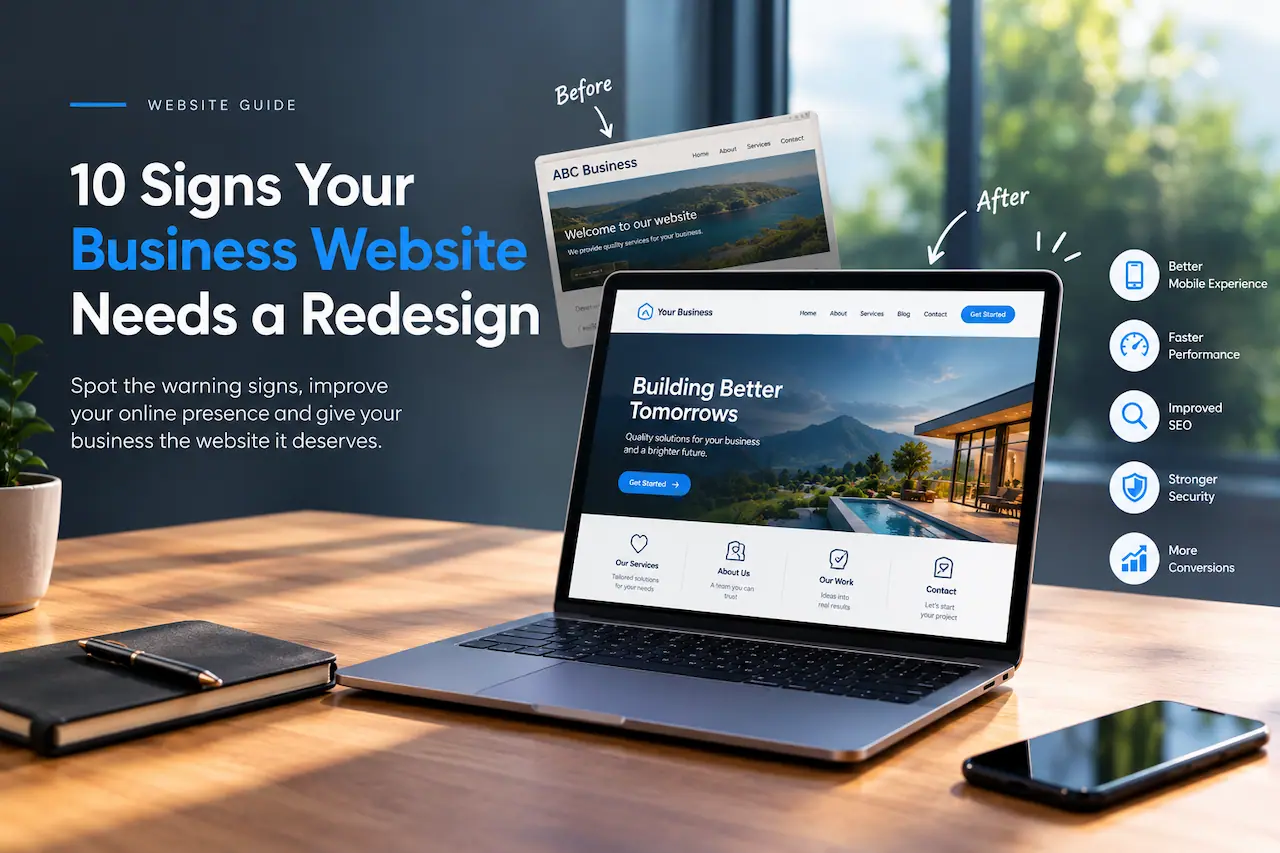
Your website is often the first place potential customers interact with your business.
If it looks outdated, loads slowly, is difficult to use on a phone, or no longer represents what your business offers, it may be doing more harm than good.
A website redesign isn’t simply about changing colors, replacing images, or giving your homepage a newer look. A good redesign should improve the way your website works for your customers and your business.
So, how do you know when it’s time for a redesign?
Here are 10 signs that your business website may need an update.
1. Your Website Looks Outdated
Design trends change, but this isn’t just about whether your website looks fashionable.
An outdated website can make your business appear less active, less professional, or behind your competitors. Visitors often form an impression of a business within seconds of landing on its website.
Look at your website from the perspective of someone who has never interacted with your business before.
Does it look professional?
Does the design reflect your current brand?
Does the layout make it easy to understand what you offer?
If your website still looks like it belongs to a previous generation of the internet, a redesign may be worth considering.
2. Your Website Doesn’t Work Well on Mobile Devices
A professional business website needs to work properly on smartphones and tablets, not just desktop computers.
Customers may visit your website while searching for your business, checking your services, looking for your phone number, or making an enquiry.
If visitors have to zoom in, scroll sideways, deal with overlapping text, or struggle to click buttons, they may leave before contacting you.
A redesign should make the mobile experience a priority rather than treating it as an afterthought.
3. Visitors Can’t Easily Find What They Need
A website can contain plenty of information and still provide a poor experience.
If visitors have to search through several pages to find your services, pricing, contact details, location, or other important information, your website structure may need improvement.
Good website navigation should help visitors answer basic questions quickly:
- What does this business do?
- What products or services does it offer?
- Why should I choose this business?
- How can I contact them?
- What should I do next?
If your website makes these answers difficult to find, a redesign can improve the structure as well as the appearance.
4. Your Website Is Slow
Website speed affects the experience visitors have when they interact with your business online.
A website that takes too long to load can frustrate potential customers, particularly when they are browsing from a mobile device or slower connection.
Slow performance can have many causes, including large images, poorly configured hosting, unnecessary website features, outdated software, or inefficient website code.
You don’t necessarily need to rebuild your entire website because it is slow. Sometimes performance improvements can solve the problem.
However, if the website has several underlying issues, a redesign may provide a better opportunity to improve its overall performance.
5. Your Website Doesn’t Generate Enough Enquiries
A website shouldn’t only provide information. For many businesses, it should also help generate enquiries, calls, bookings, or sales.
If visitors are reaching your website but very few people contact you, the problem may not simply be a lack of traffic.
Look at your website from a customer’s perspective.
Is it immediately clear what you offer?
Are your services easy to understand?
Can visitors quickly see why they should choose you?
Are contact forms easy to find?
Do your pages have clear calls to action?
For example, a service page that explains what you offer but gives visitors no obvious next step may lose potential enquiries.
A redesign can help turn the website from a digital brochure into a more useful business tool.
6. Your Content No Longer Represents Your Business
Businesses change.
You may have added new services, stopped offering old ones, changed your target market, expanded into new locations, or updated your brand.
If your website still describes the business as it was several years ago, the content needs attention.
Common examples include:
- Old service descriptions
- Outdated team information
- Previous contact details
- Old company statistics
- Services you no longer provide
- Missing new services
- Outdated photographs
- Old branding
Your website should accurately represent the business customers can work with today.
A redesign provides an opportunity to review the content and make sure the website reflects your current business.
7. Your Website Is Difficult to Update
Some older websites become difficult for businesses to manage.
You may need a developer every time you want to change a phone number, add a service, update an image, publish an article, or make another small change.
That doesn’t automatically mean the website needs a complete redesign. But it is worth examining why routine updates have become difficult.
A modern business website should give the business an appropriate level of control over its content.
For example, if your company regularly publishes articles, adds products, updates services, or manages events, the website should support those activities without creating unnecessary work.
8. Your Website Is Not Performing Well in Google Search
A website redesign can also be necessary when the existing site has problems that make it difficult to build a strong search presence.
For example, your website may have:
- Poor page structure
- Thin or outdated content
- Unclear page topics
- Weak internal linking
- Missing or poorly written page titles
- Poor mobile usability
- Slow-loading pages
- Pages that no longer match what customers search for
A redesign doesn’t guarantee higher Google rankings. SEO depends on many factors, including content quality, relevance, competition, technical health, authority, and ongoing work.
However, rebuilding a website gives you an opportunity to create a stronger structure and address problems that may be holding it back.
SEO should therefore form part of the redesign discussion rather than being added as an afterthought.
9. Your Website Doesn’t Reflect Your Brand
Your website should feel like an extension of your business.
If your logo, colors, photography, messaging, and overall visual style have changed but your website still uses your old identity, there may be a noticeable disconnect.
This can happen when a company has:
- Rebranded
- Updated its logo
- Changed its target market
- Expanded its services
- Moved toward a more premium position
- Developed a different visual identity
A redesign can bring the website in line with the brand customers see across other channels.
Consistency matters because customers should feel that they are dealing with the same business wherever they interact with it.
10. Your Competitors Offer a Much Better Online Experience
Your competitors don’t need to have better products or services for their websites to create a stronger first impression.
Visit several competing businesses and look at their websites objectively.
Can you find their services quickly?
Is their website easy to use on a phone?
Do they explain their value clearly?
Can customers easily make an enquiry?
Does the website give visitors confidence?
If your competitors consistently provide a better online experience, your website may be creating an unnecessary disadvantage.
The answer isn’t to copy another company’s design. Instead, use the comparison to identify areas where your own website could provide a better experience.
Does Your Business Need a Complete Website Redesign?
Not every problem requires a completely new website.
Sometimes you only need to improve specific areas.
For example, you might need:
- A new homepage
- Better mobile layouts
- Updated content
- Improved navigation
- Faster page loading
- Better calls to action
- A refreshed visual design
- Improved service pages
- Better SEO structure
In other cases, the existing website may have become so outdated or difficult to maintain that starting with a new structure makes more sense.
The right approach depends on the condition of your current website, your business goals, and what you want to improve.
What Happens During a Website Redesign?
A professional website redesign should start with understanding what isn’t working.
The process may include:
1. Reviewing the Existing Website
First, identify the website’s strengths, weaknesses, outdated content, usability problems, and technical issues.
2. Defining New Goals
Decide what the redesigned website needs to achieve.
For example, your goal might be to generate more enquiries, improve online sales, promote new services, or strengthen your company’s professional image.
3. Improving the Structure
The navigation, page hierarchy, content and calls to action can then be reorganized around the needs of your customers.
4. Updating the Design
The visual design can be refreshed to create a more modern and consistent experience across desktop and mobile devices.
5. Improving Content
Old or unclear content can be rewritten, while new information can be added where necessary.
6. Testing Before Launch
The redesigned website should be checked across different devices and browsers, with important forms, links and business functions tested before launch.
The goal isn’t simply to create a website that looks newer. It should work better too.
How Often Should a Business Redesign Its Website?
There is no fixed rule that says a business must redesign its website every three or five years.
Some websites remain effective for many years with regular updates and maintenance. Others become outdated much sooner because the business, technology, audience, or requirements have changed.
Instead of focusing on the age of your website alone, look at its performance.
Ask yourself:
Does this website still represent my business?
Does it work well for my customers?
Does it support my current business goals?
Is it easy to maintain and update?
Does it perform well on mobile devices?
If the answer to several of these questions is no, it’s probably time to evaluate your website more seriously.
A Website Redesign Is a Business Decision, Not Just a Design Project
It’s easy to think of redesigning a website as a visual project.
New colors. New fonts. New images. New layouts.
But a successful redesign should go further.
Your website should help people understand your business, trust your brand, find the information they need, and take the next step.
That could mean making an enquiry, requesting a quotation, booking an appointment, visiting your business, or purchasing a product.
The redesign should therefore start with the question:
What does the business need the website to accomplish?
Once that is clear, design and development decisions become much easier to make.
Conclusion
Your website doesn’t have to look perfect to be effective. But it should remain useful, trustworthy, accessible and relevant to your customers.
If your website looks outdated, performs poorly on mobile devices, loads slowly, generates few enquiries, contains outdated information, or no longer represents your business, a redesign may be worth considering.
A good website redesign isn’t about changing everything for the sake of change. It’s about identifying what isn’t working and creating a better online experience for your customers and your business.
At Web One Solutions, we help businesses design and develop modern websites that are built around their goals, customers and services. If your current website no longer represents your business, we can help you identify what needs to change and plan a redesign that makes sense for your business.